

DSCF0211
IMAG0243
DSCF0182
DSCF0182
DSCF0108
DSCF0063
DSCF0041

Latest

Just in time for Cinco de Mayo – Guacamole!

I thought it has been a while, and I have some things in the works, but I thought this is too good to not to share with you. Besides, with tomorrow being Cinco de Mayo, it is pretty timely. (Not that there is a bad time for guacamole!)

This recipe is kind of a rough guide, feel free to tweak it as you see fit!

1 avocado, diced (I’ll give you the easy way to do that in a second.)

1/2 red onion finely diced

1 roma tomato finely diced

1/4 jalapeno finely diced (more or less depending on how spicy you like it.)

1/4 bunch cilantro finely chopped

ground cumin, oregano, salt and pepper to taste

lime juice to taste

First thing, split the avocado in half length-wise. Run your knife around the pit, and once you get all of the way around, give the two halves a twist, and they will come apart. Next, remove the pit, this is the dangerous part. Use your chef’s knife, and tap the pit just hard enough to stick in it, and give it a twist. I generally chop through the pit once I have it out of the flesh, but there are other ways. Carefully cut flesh of the avocado while it is still in the skin. The tip of your knife gently following the inside of the skin (but not through!) will slice it nicely. Cut it length-wise, and across. Next, use a large spoon and scoop out the flesh, about half the depth of the avocado, and then scoop again all the way at the skin. Repeat with the other half. You’ve just diced an avocado.

When you cut the cilantro the easiest way to do it is to hold the stems of the bunch so the leaves point down at an angle, and use the blade of your knife to slice the leaves off. Then just chop the leaves.

Place all of the ingredients in a bowl, and mix well. Obviously, as you season you should be tasting to see if you need more of something. You don’t want to dump in a bunch of anything all at once, because it is a lot easier to add things than to get them out. If you like it smoother, smash the avocado as you mix.

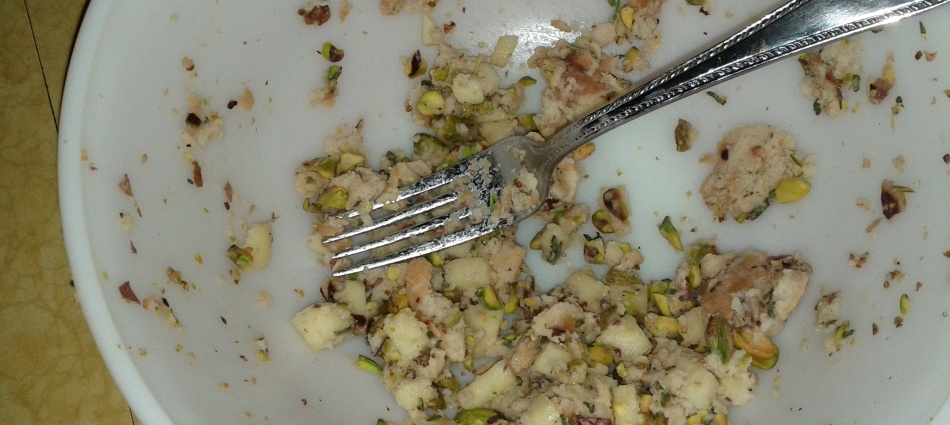
When you’re done it should look something like this:

Preserved Lemons… A Prelude

I have been aware of preserved lemons for a while, but to the best of my knowledge I had never encountered them. North African cuisine is not something I have a lot of experience with, but the chef recently added a dish to the menu that uses some of the flavors, and it is naturally gluten-free! A couple of major flavor components in this dish are preserved lemons and smoked paprika, and let me tell you it is quite a combination!

Obviously, smoked paprika you are probably not going to make, but you can make preserved lemons if you want.  All you need is salt, lemons, lemon juice and a clean jar to put them in.

First, you want to make sure the lemons are nice and clean.  There are washes you can use, but I don’t think they have been shown to be any more effective than water. Take your knife and cut down about 3/4 of the way through from the bud end. Then turn it 90 degrees, and cut it again. Once you have all of the lemons cut that you want to hold each one over the jar and pour salt into it.  Set them in the jar, and then pour lemon juice over them.  The lemons float, so there isn’t a lot you can do about them bobbing up to the surface.  I kind of swish them around once in a while when I think of it. I don’t know if it helps.  They need to sit for a couple of weeks. Pop your jar in the fridge, and don’t worry about it for two weeks. You’re done with them. They won’t go bad any time soon! The  salt and juice will actually soften the lemons quite a bit.  Also, the pith  will not  be bitter like it  is  in a  fresh  lemon.We will be using some of these very soon, and I am excited about it. Between the smoked paprika I picked up the other day and these lemons there is a ton of flavor to be enjoyed! Of course there will be a bit more to it.

Pollo Adobado con Papas

I have always enjoyed PBS programs, and a while back I found Rick Bayless‘ show One Plate at a Time. Chef Bayless is known for making traditional Mexican food,  and not screwing it up. Most of the “Mexican food” that we actually eat around here, and probably near you is Tex-Mex. Not that there is anything wrong with that, at all! It is just that Mexican food is a lot more diverse than you typically get to see.

Amy and I were looking for something to have for dinner, and I grabbed One Plate at a Time. As I flipped through my eye caught Red Chile Marinated Chicken with potatoes. This sounds like my kind of food. Looking through the ingredients there were only a couple of things we didn’t have.  Amy and I went to the store and picked up a couple of things, and we were ready to go.

The chicken is going to get a ton of flavor from a marinade that uses chiles and a few spices. Really this is very simple.  How much simpler can it get than roasted chicken and potatoes? The marinade is going to take this beyond a plain roasted chicken though.

vegetable oil

3 oz dried ancho chiles stemmed, seeded and torn into pieces

3 cloves of garlic

1 teaspoon dried oregano

1/2 teaspoon fresh ground black pepper

1/4 teaspoon fresh ground cumin

1/8 teaspoon ground cloves

1 teaspoon sugar

salt

1/3 cup cider vinegar

1 3 1/2 pound chicken

10 small red skinned potatoes, washed and halved

First, heat vegetable oil in a skillet and add the chile pieces, and lightly toast them. (In the interest of full disclosure, I was a little over excited and skipped the toasting. It was still fantastic, but it would have been better if I had done it.) Then place them in a bowl with two cups of water to rehydrate them for about 20 minutes. You might need to put a small plate on top of them to keep them from floating.

Place the chiles(and the water, there is lots of flavor in that!), garlic, spices, sugar, salt (to taste maybe a teaspoon), and vinegar in the blender. Puree until smooth. Set this aside.

Now for the fun part! Have you ever spatchcocked a chicken? I have, once, but I will do it again! Spatchcocking a bird refers to flattening the bird out by removing the spine and breaking the keel bone. To do this you will need a pair of kitchen sheers. A paring knife might also come in handy. Place the bird breast down on a cutting board, and using your sheers, cut along one side of the backbone.  Then do the same thing all the way up the other side.  I found it easer to start at the larger opening in the chicken. Once the spine is out, carefully open up the body. Turn the chicken skin side up.The next thing that you need to do is to break the keel bone from the ribs. The easiest way to do that is to just make a fist and smack the center of the breast. You may have to hit it several times. You’ll know when it breaks. The breast will be a lot more flexible.

Put the bird into a plastic bag or bowl and pour about half the marinade over the bird. You want to cover the inside and outside. Leave it in the fridge like this for at least an hour, and overnight would be great.

Preheat your oven to 375F. You want to tuck the legs back so that everything cooks evenly.  Cut a slit in the skin between the thigh, and the breast, and tuck the end of the leg into the hole. I also tucked the wing tips under the thighs. (You can see this in the picture below.) Place the bird skin side up in your roaster. Toss the potato halves in olive oil, salt, and pepper, and arrange them around the chicken. Pour 1/3 of a cup of water in the roaster, but not on the chicken. Cover the pan. Our roaster has a lid so we used that, but foil will also work. Put the chicken in the oven. Every 15 minutes or so you are going to take the  cover off, and stir the potatoes. This will help them cook evenly, and also get them coated with the chicken juices and adobo that you rubbed all over the chicken. Your total time will depend on a number of factors, but you will probably be looking at roughly an hour, maybe an hour and fifteen minutes. You should use your instant read thermometer in the thickest part of the thigh. You’ll be looking for 160F.Once your chicken is at 160F, get the leftover marinade, and spoon some of it over the chicken, and potatoes.  This will act as a bit of a glaze. Put it back in the oven for another 10 minutes or so, but leave it uncovered.Now we are to the hard part. Take the bird out of the roaster, and put it on a cutting board, and cover it with foil. Don’t touch it for about 10 minutes.

Did you make it?  Cut the bird between the breast halves, and between the breast and thighs, and serve.

Potato and Cheese Ravioli with Pesto Cream Sauce!

Amy and I didn’t really get a chance to celebrate Valentine’s Day on Valentine’s Day. We went to lunch for my birthday, but I never had a chance to make her a really spectacular dinner that night.  I told her that she should figure out what she wants, and I would make it for her. She decided that she wanted cheese ravioli. I never really liked cheese ravioli, so I asked Mario Batali(via Twitter) what would be the best blend of cheeses. He replied, potato, ricotta, and parmesan. Who  am I to argue with Mario Batali?First I made the filling:

1 T oil

2 T butter

2 cups Yukon gold potatoes cubed and boiled

1 small onion, diced

5 cloves of garlic cut in half

1/2 cup milk

1/2 cup ricotta

1/8 cup parmesan

1/8 cup pecorino romano

1 egg

salt and pepper

herbes de provence

Boil the potatoes until the are tender in salted water. Saute the onions until they are tender. Place the milk, butter and garlic in a small pot, and bring up to a simmer over low heat. Place the cooked potatoes and onions in a bowl and add the milk mixture and mash the potatoes.  Add the remaining ingredients. Place in the fridge to chill while you make your pasta.

As far as the pasta goes, I pretty much used the same recipe and method as I used a while back for my butternut squash ravioli, and it worked great. I did use a different flour blend this time. I used Andrea’s flour blend. It works well for anything I have tried it for. Other blends will work fine too.  Amy bought me a very nice French rolling pin for Christmas, and it works wonderfully! I was able to roll the dough out thinner this time. (I used an empty wine bottle last time, and it worked ok. The rolling pin worked much better. Although I grew up using the roller style I really like using the tapered type. It is more comfortable for me.)

I let the dough rest for a little while, although it wasn’t strictly necessary. Then I rolled out the dough.  Each ravioli gets less than a tablespoon of the filling, and then is sealed up with a little water along the edge of one piece. You will also want to crimp the edges with a fork. You don’t want your filling coming out of the ravioli you worked so hard to make! I find it easier to work with half of the dough at a time.   This means that I can work with fewer ravioli at once. Get them filled and roll out the next set. If you wrap the dough in plastic it won’t dry out.

By now you should have a large pot of boiling salted water ready.

Once all of your ravioli are filled  drop them in the pot. You want to be gentle, they are delicate. Slide them in one at a time, making sure not to crowd the pot.  I got ten ravioli in at once with no problem. When the ravioli float they are done. The filling is already cooked, and there is not very much so they don’t take long to heat through. I’d guess they took about 4 minutes, tops.

While the ravioli were cooking I melted some butter in a skillet, and when the ravioli were done I drained them well, and transferred them to the skillet. I poured in a little white wine, and let it reduce a bit. Next, I added a couple of tablespoons of pesto. (I’ll talk about making pesto soon, but this was pre-made.) I gently stirred the pasta to distribute the pesto, and added about half cup of heavy cream, and as soon as that came up to a boil I added  parmesan to the sauce. I added it slowly, and mixed it in until the sauce had thickened nicely. All that was left was to get them onto a plate! I had some asparagus, a salad, and a glass of wine. It was a nice way to celebrate Valentine’s Day!


BBQ in January? Absolutely!

My family tends to get that I really do enjoy cooking, and that frequently means that I get some really cool gifts. This year, for example I got a stovetop smoker from my brother and his wife! Obviously it can go in the oven as well. It has a lid that slides on for smaller items, and works pretty well. I tried it a few days ago with some chicken breasts, and was pretty happy with the results.  Of course that made me think what else can I do with this? I have a feeling I am going to be smoking lots of things. It is actually very nice since you don’t want to rush it there is time to do other things while dinner is cooking!

The other day Amy told me that she was going to hang out with a friend on Friday night. That meant I was on my own for dinner! I also happened to go to the grocery store and find a deal on a very thick pork loin chop. You can see where this is going…

In the past when I make BBQ I make a dry rub, and leave that on the meat.  Typically I BBQ ribs. My method involves my dry rub, and then braising the ribs in beer in a foil pack for several hours. It is the old low and slow thing. 250F for 3 hours means that the bones actually pull out of the St Louis style ribs.  Then I sear the outside over the charcoal grill, and throw on sauce. (I know, but I’m from St Louis, and that is kind of how it goes.)

I don’t really have a recipe for my dry rub, I just kind of eyeball it.

Brown sugar, kosher salt, ground ancho chili, cayenne pepper, ground cumin, ground coriander,  thyme, ground black pepper, sometimes ground mustard if I happen to think of it.  Everything gets combined, and then spread evenly on the meat.

As far as the smoker goes… I’m going to use the hickory chips. Piggie getting ready to meet the smoke!Obviously I have no idea if you have a smoker or not, but if you do you should follow the instructions as far as using yours. Mine I started on the burner which gets the wood chips started. For my smoker they are essentially sawdust.  You just have to spread a couple of tablespoons in the bottom. It has a large pan, with a smaller pan that fits inside with a removable rack. Then a lid for the whole thing.  I poured about half a Bard’s beer in the drip pan figuring a little flavorful liquid wouldn’t hurt anything, and then drank what was left! (What would you have done? Yep!)*

 So, everything looked like it does in the picture above, and I turned on the burner. After a minute or two I started seeing wisps of smoke coming around the drip pan, so I slid the lid over the whole thing, and slid it into the oven I had preheated to 250F. Obviously when you put a piece of meat in the oven at 250F from less than room temperature you are not in a hurry to eat, and I figured 2 solid hours would get me where I wanted to be.

Two hours later…I used my thermometer to make sure I had reached a safe temperature, and I was in good shape. Now, I closed the lid, and let it rest for about another 15 minutes. (This was hard. I pulled the bone out of it accidentally, and a chunk of meat came with it, so good!!)

I moved it to a plate, and pulled it apart with a couple of forks. This is really pretty easy to do. If you have cooked the pork enough it will pretty much shred into bite sized pieces just sticking the forks in and moving them a little.From this point if you don’t know what to do I don’t really know if I can help you!!! Serve with your favorite sides, and enjoy. I’m not going to even get into the entire BBQ sauce debate. Do what you like!

I have leftovers which are going to make an awesome lunch or two!

* What I ended up with was fantastically tasty, but not quite as smoky as I had hoped for.  I think I know why. This is only the second time I have used it, so I am still kind of getting used to how it works. I may have made a mistake or two with the whole thing. Not bad mistakes, but they may have prevented me from getting as much smoke as I would have liked. First, the ignition temperature of wood, is 275F. If nothing else the temperature in the oven wasn’t high enough to maintain the burning chips. The second mistake was probably the beer in the drip tray. The beer in the drip tray will never go above the boiling point of water (give or take), and since the beer is directly on top of the wood chips it kept the pan cooler than it needed to be for a consistent smoke to happen. Without the beer it may have been ok with the wood in the oven at the slightly lower temperature since it started burning on the stove top.  I really don’t mind making mistakes this tasty! Plus now I have an idea of what to do different for next time!

A new chapter in my life

A couple of days ago I was waiting for orientation to start for a second bachelor’s degree. My previous degree was in the arts, and is only useful in that it fulfills lots of general requirements. I was kind of unfocused when I went to college. My degree is in General Studies, because I changed my major several times, and I just wanted to get out.

Today I started to work on a degree in dietetics. After a lot of reflection I realized that I would have a lot to offer people as a dietician, plus I have a different perspective that will help me when dealing with clients/patients. I can already cook my ass off, plus I was actually good at science when I was in school, and I have some pretty amazing support and a fantastic tutor if I need help. My friends and family have been very supportive of me going back to school, and that has been great. Although I hope I don’t end up needing a whole lot of help, my sister just got her PhD in biology… well there was more, but I am not sure I can explain… It involved traveling, and monkey poop. If I need help, I’m pretty sure she will be high on the list of people I call!

It has taken a while for me to finally make it to this point. There have been several false starts, and a lot of frustration. I’m sure there will be lots of challenges coming up, but I have a lot more focus and understanding of where I am headed now than I did when I was 18.  Realistically, what the hell do most 18 year old kids know about what they want to do for the rest of their lives? What challenges will they face? Do they know what their real strengths are? These are things that I know I have worked out over the last twenty years, maybe not completely, but I am better off now than I was then.

Twenty years after I graduated from high school I finally found a direction that actually makes sense for the skills I have, the way I think, and that I actually do want to help people feel better. I’ll be in my early to mid-forties before I finish with this degree, but I am excited about it. Of course it would have been nice to know all of this 20, even 15 or ten years ago.

I’ve also given myself a goal that I will be working on over the course of the next several years that I think will be a huge help for anyone with a dietary restriction/food allergy/food sensitivity. That is enough about that now, but when I am ready you will know what I am doing, and you will be excited!

Cooking School Part 1 (A little background)

After writing my post about making coq au vin a while back, I realized that when I’m in the kitchen I have some advantages.  I would like to help you develop a similar set of skills. I wouldn’t be surprised if you are not interested in spending your life in a kitchen. However, there are a lot of skills that you can learn at home that will serve you well, and my goal with this little series of posts is to help you learn some of them.

Your first job in a commercial kitchen is washing dishes. While you do that, you also learn to do some prep. Frequently, it involves chopping a pile of stuff into whatever size and shape the chef would like. There are lots of terms to learn, and techniques to be practiced. During one shift I cut thirty pounds of various vegetables into 3/4″ pieces for roasting. What does that do for you? Practice, practice, practice. There was plenty of time, and there was lots to do. During this time I was told things by the chef and sous chef like, “I need 2 pounds of mirepoix for stew” or “roll cut these carrots”. Essentially, you will spend a lot of time with a peeler and a knife.

This is how people have always learned to work in a kitchen. Each skill builds on the next. Going to culinary school speeds up the process some, but it still won’t give you the hours of practice with each skill that you would have working under a chef.

Once you have the hang of fabricating vegetables, you will be moved onto other tasks. Next you might be given the job of using the vegetables, and some other materials to make basic stocks. Essentially, you will be making the basic components of what is needed for  lunch, dinner or a party that is being catered.

When the salad guy stops showing up you might get a promotion from dishwasher to the salad station! This is kind of how kitchens work. Each one is different, but generally the first station you do is salads or pantry. This is sometimes called Garde Manger in the brigade system used in large kitchens. As you move from station to station you learn new skills. One of the first things you will learn on the salad station is how to make salad dressings, and other things like pesto. During service (when food is being served to guests in the dining room) you will make salads, sandwiches, cold appetizers, and some hot appetizers that can be done quickly. Generally, these are very simple things to do, but you will be busy. This gives you the chance to really practice what you have learned and apply it. (Usually at high speed!)

So, the goal of this series of posts is to walk you through the things you would learn as a dishwasher or pantry cook.  We’re going to do things like make a vinaigrette, make pesto, use a knife properly, cook eggs, and maybe make some candied nuts. There are probably  a few other things as well. Then, I will show you how to use what you just made. These are all tasty, easy, and useful. Hopefully, this will inspire you to try some new things, and eat something great!

My New Year’s Resolution of sorts…

I’m not really sure why, but 2011 was the year that I meant to do more posting, and ended up not doing as much. My goal this year is to increase my blogging somewhat. I’ll also be attending school again, and obviously that will have to take a central role, but knowing the class load I have for this semester I don’t think it will be a huge problem. I have a few ideas to work through for you, and hopefully they will be very helpful for both the gluten-free and non-gluten free readers.

Hope you all have a great 2012, and I hopefully will have something yummy to post for you in the next few days! I know I have some interesting projects for myself.

My New Year’s resolution that concerns you… “This year I am going to cook my ass off!”

I Made Coq au Vin on a Tuesday night!!

So, I had some chicken in the fridge that I wanted to do something with. I decided I would make coq au vin. Why not? Right?

Of course right about now you might be thinking, “But that needs to marinate in red wine overnight??!?” And you would be right. So I made kind of a quick and dirty coq au vin.  It had most of the right stuff, and tasted pretty damn good, but it wasn’t quite what you would get from a traditional recipe.  Of course, it took a lot less time too! Total time: under two hours to go to the store to get a few things I needed, wash a few dishes, and get dinner cooked and on a plate! With a traditional recipe you would still be braising your chicken (If you had already marinated it!). I found this on the Epicuirous web site, and figured I’d give it a shot.  I kind of tweaked it a little, but I almost always do that.

4 strips of bacon, cut into lardons or thick strips

4 boneless skinless chicken breasts (I only had two handy so I went with that, but I had plenty of the sauce left.)

8 oz crimini or button mushrooms quartered

2 medium onions quartered (or you could use small onions like cipollinis or pearls.)

4 cloves garlic minced

1.5 cups dry red wine

1.5 cups chicken stock

Chopped flat leaf parsley

I didn’t thicken this, but I did let it reduce.  You could use a corn starch slurry if you want to thicken the sauce a bit before you serve it. The recipe called for a few tablespoons of AP flour to be whisked in, but that isn’t really helpful in our case.

There are a few steps to this, but it is nothing really complicated.

The first thing to do is heat some oil in a skillet, and add the bacon.  Over medium heat cook the bacon until it is crisp and brown.  Remove it from the pan. Season the chicken with salt and pepper.  Sear the chicken on both sides, and remove it. 

Now you can add the mushrooms, onions and garlic to the pan and saute them until they are lightly browned. Now, as you can see in the pictures there is a bit of brown stuff on the bottom of the pan.  That is a good thing, and it is why I didn’t use a non-stick skillet for this. That is fond. What that means is that we have a sauce to make! Deglaze the pan by pouring in part of the wine and scraping the bottom with your spoon or spatula. This will loosen up the bits from the bacon, etc.. Then add the rest of the wine and the stock, and bring it up to a boil.Return the chicken and bacon to the pan, turn down to a simmer and cover it.  Cook until the chicken is cooked through. Stir in chopped parsley, and serve! In this case I served it with some roasted potatoes and asparagus!  Not too bad for a Tuesday night! Oh, and of course it was gluten free.  Like I said you could thicken it with a corn starch slurry, in that case you would want to take the chicken out when you were ready to serve, and whisk it in while the sauce boils.

Post Thanksgiving Turkey Wrap-up!

If you’re anything like me you have a turkey carcass wrapped in foil that you have no idea what to do with.  It probably has a leg, a couple of wings, and a breast that have not been touched. I’m not going to just hack at the turkey until I think it isn’t going to be any good to eat though. Hopefully, you won’t either!

The first thing you want to do is get the meat off of the bones.  The legs and wings are pretty easy to deal with. You can remove them just like you would on a chicken, and then pick the meat off the bones.  The breast that is still intact on your bird may be a bit more daunting. It is not as hard as you think.

To deal with the breast use your chef’s knife and cut straight down, parallel to the keel bone, and then follow the contour of the rib cage. This will cut off the majority of the the breast.  It is not hard, but it can take a bit of practice. Once you have it cut off you can lay it down on a cutting board and slice it for serving.

If you decide to make stock, (and you should) it is really very easy. Take the carcass, skin, bones, and whatever leftover bits of meat are clinging to it, and place them all in a pot.  Throw in some garlic, onions, celery, and carrots, some bay leaves and thyme, and cover with cold water. You should not salt your stock.  If you decide to reduce it you will end up with a sauce that is too salty.  You can always add salt when you want to use it. Put the pot on the stove and bring it up to a simmer.  That is all, but you don’t want the stock to boil or it will be cloudy.  The simmering water will break down the collagen in the bones and you end up with gelatin. This is a good thing, and your stock will be nice and viscous. (I was always freaked out by the brown jelly on cooked cold turkey as a kid, what did I know? I get it now!)Simmer your stock.  After a few hours, strain out the solids and cool it down.   When your stock is cool it should have the consistency of jelly. From there you can do lots with it.  You can make sauces, soups, you could freeze it to use later.  Freezing it can be very helpful since there is a good chance you may not use all of the stick you have before it goes bad.  If you freeze it in small portions you can add it to things when you need it.

Hopefully this will inspire you to tackle that turkey in your fridge! Stock is very easy, and we both know you have the raw materials already.  Just go ahead and do it!  You won’t regret it.

Follow

Get every new post delivered to your Inbox.

Join 123 other followers